支持模糊查询,支持通配符和拼音查询, 帮助 。
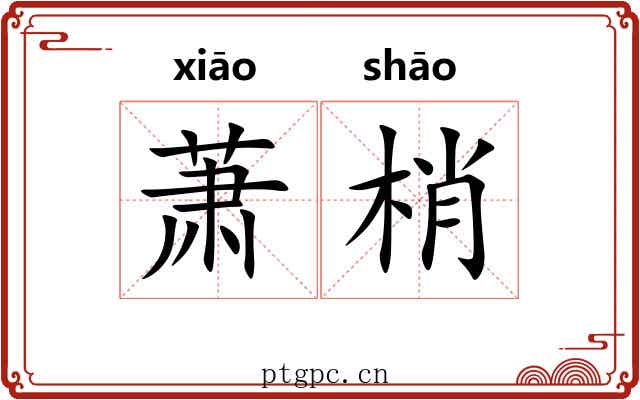
萧条;凄凉。
萧条;凄凉。参见“萧骚”。
引南朝 梁 江淹 《待罪江南思北归赋》:“木萧梢而可哀,草林离而欲暮。”元•萨都剌 《元子游戏竹木》诗:“萧梢瘦竹卧疎雨,槎枒老树悬春风。”清•严允肇 《穆陵关》诗:“萧梢谷风起,岧嵽林光含。”
["①树枝或条状物的末端。如 树~。末~。~头。~林。②末尾。如 眉~。收~。③古代奏乐时拿的竿子。④古同“艄”,船舵尾。","①像圆锥体的形状。②柱形物体的横剖面向一端面逐渐缩小的形式。"]详细解释
["①即“艾蒿”。②冷落,没有生气的样子。如 ~然。~瑟。~索。~飒。~森。~骚。~疏。~条。③〔~~〕①象声词,形容马叫声或风声,如“风~~兮易水寒”;②头发花白稀疏的样子,如“华发~~老遂良,一身萍挂海中央”。④〔~墙〕照壁,喻内部,如“祸起~~”。⑤姓,如南朝梁有萧统。"]详细解释
tóu shāo
yǒu shàng shāo méi xià shāo
liù shāo
gēn gēn shāo shāo
xiāo shū
xiāo să
shāo ér
shāo mă
shāo zǐ
chuān shāo
yī shāo
xiāo zhāng
mò shāo shén jīng
xiāo liáo
xiāo lǜ
ài xiāo
liáo xiāo
piāo xiāo
fēng yǔ xiāo tiáo
méi xià shāo
páo shāo
xiāo qiáng zhī huò
xiāo dào chéng
jiăo shāo tiān
xià shāo tóu
yún shāo
sēn shāo
niăn shāo zǐ
chéng bài xiāo hé
xiāo qiáng huò qǐ
míng shāo
tōng shāo
xiāo fǔ zhī zhū
xiāo xiāo sè sè
xiāo xiàn huà
xiāo xiāo shù xià